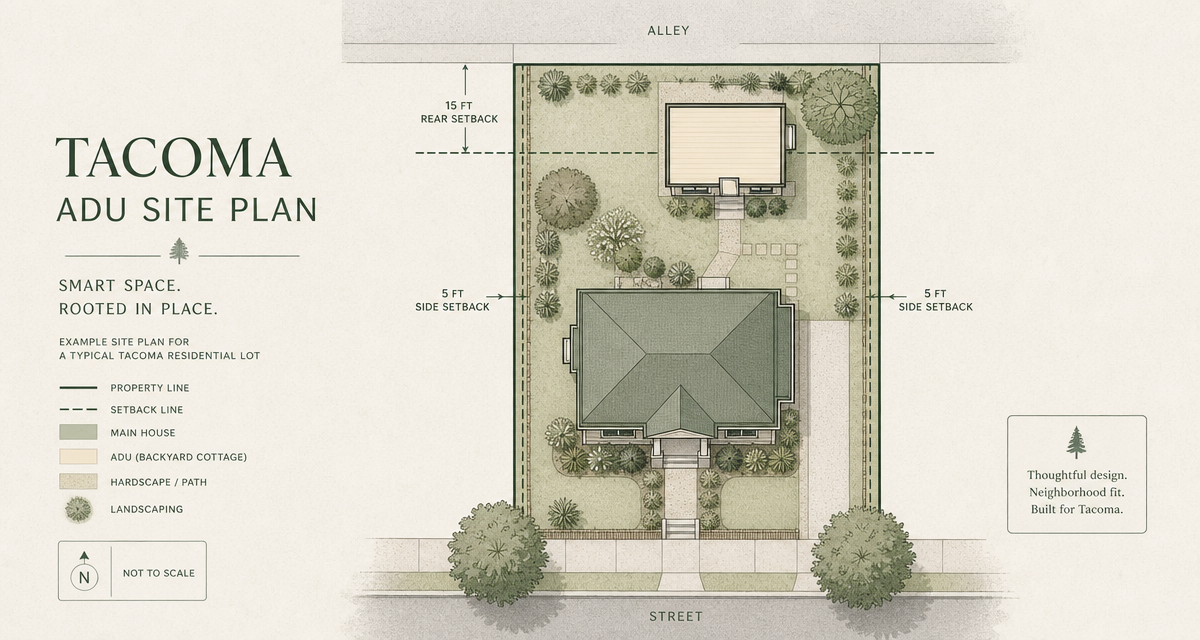
Quick answer. Tacoma allows two ADUs per lot on any legally established lot in a residential zone, regardless of lot size or width. The living area of each unit is capped at 1,000 sq ft, height follows the zone's normal limit, a detached unit sits in the rear yard with 5 ft side and 15 ft rear setbacks (none from an alley), and no parking is required.
Key facts
- Two ADUs per lot in Tacoma, on legally established lots irrespective of lot size or width, in any zoning district that permits residential development (City of Tacoma ADU tip sheet L-150, TMC 13.06).
- Size: living area of the ADU is limited to 1,000 sq ft, excluding non-living areas.
- Height: the standard height limit of your zone applies — there is no separate, lower ADU height cap.
- Detached setbacks: rear yard placement, 5 ft minimum from side property lines (8 ft if the main entrance faces a side line), 15 ft from the rear line, and no setback required from an alley.
- Parking: not required. If you add parking, it must sit in and be accessed from the rear of the lot, and you cannot remove the parking required for the main house.
- Open space: the site must keep at least 10% of the lot area as usable yard space (TMC 13.06.020).
- Walkway: a separate entrance needs a 3 ft minimum walkway to the nearest sidewalk or right-of-way, in materials distinct from the driveway.
- Utilities: each detached unit needs external sewer and water connections outside the unit, plus its own separately addressed street number.
- Unincorporated Pierce County: two ADUs per lot of record inside the Urban Growth Area, one outside it (PCC 18A.37.120, amended by Ordinance 2025-516s, codified December 2025).
- State floor: no Washington city or county may cap an ADU below 1,000 sq ft, require owner occupancy, or charge ADU impact fees above 50% of the principal-unit fee (RCW 36.70A.681).
Home in Tacoma is why 2026 looks different
Tacoma's Home in Tacoma zoning regulations took effect February 1, 2025. They opened ADUs, rowhouses and a wider range of housing types across all residential districts and folded the statewide ADU mandates into local code. The practical result for a homeowner: the old questions — is my lot big enough, is my street wide enough, do I have to live here — mostly stopped being the gate. Two units per lot is now the baseline, and the lot's physical realities decide the rest.
That is the real difference between Tacoma and Seattle in 2026. Seattle's constraint is usually floor area and 50% lot coverage on a tight lot; Tacoma's typical parcel is wider and deeper, so the binding constraints are more often utilities, slope and access. If you are comparing the two markets, our Washington ADU law update covers the statewide layer and what a DADU costs covers the money.
The Tacoma detached ADU envelope, in plain numbers
Start with the rear yard, because that is where a detached unit has to go. Take the rear-yard rectangle, pull 5 ft off each side line (8 ft on any side the main entrance faces), pull 15 ft off the rear line unless you back onto an alley — in which case that setback drops to zero. What is left is your buildable footprint. Then confirm the fire separation the building code requires between your new unit and the house or garage already standing.
Two more standards quietly shape the site plan. The lot has to retain at least 10% usable yard space, so a footprint that swallows the backyard will get flagged even when the setbacks work. And a unit with its own entrance needs a 3-foot walkway running to the sidewalk or right-of-way, in a material visibly different from any driving surface — worth drawing on day one rather than discovering at review.
Height is the pleasant surprise. Tacoma does not impose a special ADU height cap; the ADU follows the zone's standard height limit, which is what makes two-storey cottages workable on narrower lots where the footprint is tight. Look up your zone's limit before assuming a single storey is your only option.
Unincorporated Pierce County is a different rulebook
If your address says Tacoma but your parcel is outside the city limits — Spanaway, Parkland, Frederickson, Graham, much of the Gig Harbor Peninsula — the City of Tacoma's code does not apply to you. Pierce County Code 18A.37.120 does, and it was amended by Ordinance 2025-516s, codified in December 2025.
The headline distinction is geographic: two ADUs per lot of record inside the Urban Growth Area, one ADU outside it, accessory to a single-family residence. Outside the UGA the practical gates are water supply and sewage disposal rather than zoning — a septic-served parcel is sized by bedrooms, and adding an ADU usually means proving capacity before anything else moves. We wrote that process up in detail in can you build an ADU on septic in King or Pierce County.
We do not publish the county's numeric setback and size standards here, because the December 2025 amendment reset several of them and we verify current numbers per parcel rather than from memory. The statutory floor in RCW 36.70A.681 still applies — no cap below 1,000 sq ft, no owner-occupancy requirement — and the jurisdiction finder below links straight to the adopted chapter.
The other Pierce County cities
Puyallup, Lakewood, University Place, Gig Harbor, Bonney Lake, Fife, Milton and Edgewood each run their own land use code, and each had to bring it in line with HB 1337. The statewide floor gives you a reliable starting point anywhere in the county: at least two ADUs per lot inside urban growth areas, no size cap below 1,000 sq ft, at least 24 ft of allowed height, no owner-occupancy requirement, no parking mandate within a half mile of major transit, and ADU impact fees capped at half the principal-unit rate.
What varies between them is design standards, tree and critical-area overlays, sewer availability and the fee schedule — which is exactly where a project budget gets made or broken. Use the finder below to open the right chapter for your jurisdiction, then bring the numbers you find to a site visit.
Permits and utilities: where Tacoma projects actually slow down
Creating, converting or legalizing an ADU in Tacoma requires construction permits, and the set depends on scope: building, plumbing, mechanical, site development, side sewer, stormwater, water and electrical. Applications go through the online portal or in person at Planning and Development Services, 747 Market Street. Current review-time estimates are published by the city and shift with volume, so treat any timeline you read — including ours — as a planning figure to confirm, not a promise.
The line item that most often surprises Tacoma homeowners is the side sewer. Each detached unit needs its own external sewer and water connections, and older neighborhoods sometimes need the side sewer replaced or re-routed to carry a second dwelling. Stormwater review is the second one: new impervious area triggers on-site management, and a flat, clay-heavy backyard can turn that into a real number. Both are site-work costs, not construction costs, which is why they rarely show up in a per-square-foot estimate.
Finally, plan for the small administrative items early: a separate address visible from the street, interconnected smoke and carbon monoxide alarms, and independent heating and water-heater control for each dwelling.
Does it pencil in Pierce County?
Tacoma is one of the strongest ADU markets in the state precisely because land is more generous than in Seattle while rents have held up. South Pierce County adds a second demand engine most owners underestimate: Joint Base Lewis–McChord, where housing-allowance-backed tenants fill well-built backyard units quickly — the case is laid out in renting your ADU to military families.
On the ownership side, Washington's three-year property tax exemption for a qualifying ADU has a filing deadline that comes before completion; the mechanics are in ADU property taxes in Washington. And if you are weighing a cottage against converting what you already have, garage conversion vs DADU runs the comparison.
Pierce County rule finder: what applies to your address
Pick your jurisdiction. City limits matter more than the mailing address — a Tacoma address is not always a Tacoma parcel.
Two ADUs per lot, 1,000 sq ft of living area each, no parking required — the rear-yard setbacks decide your footprint.
| Units per lot | 2, on any legally established lot regardless of size or width |
|---|---|
| Size | 1,000 sq ft of living area (non-living areas excluded) |
| Height | The standard height limit of your zone |
| Detached siting | Rear yard of the primary structure |
| Side setback | 5 ft — 8 ft if the main entrance faces that line |
| Rear setback | 15 ft; none required from an alley |
| Parking | Not required; if provided, rear of the lot only |
| Usable yard | At least 10% of the lot must stay usable yard space |
| Walkway | 3 ft minimum to the sidewalk, distinct from driving surfaces |
| Utilities | External sewer and water connections outside each detached unit |
Verified against the City of Tacoma ADU tip sheet (L-150) and TMC 13.06. Home in Tacoma zoning took effect February 1, 2025.
- Tacoma ADU tip sheet (L-150) — City development standards summary
- TMC 13.06 — Land Use Regulatory Code
- Home in Tacoma — Zoning program overview
- RCW 36.70A.681 — Statewide ADU floor — size, height, two units, parking, impact fees
Lot-readiness checklist for a Tacoma detached ADU
Tick everything you can confirm today. The verdict updates as you go, and you can send the result to us with one click.
Complex lot — worth a real evaluation (0/8 confirmed)
Several of the constraints that drive cost are unresolved. That does not mean no: it means the feasibility work should come before any design spend.
Serving King, Pierce and Snohomish counties. Mon–Fri, 8am–6pm PT · Sat 10am–4pm PT.
Frequently Asked Questions
How many ADUs can I build on my lot in Tacoma?
Two. Tacoma allows two ADUs per lot as an accessory use to a primary residential structure on any legally established lot in a zoning district that permits residential development, irrespective of lot size or width.
How big can a Tacoma ADU be?
The living area is limited to 1,000 square feet, excluding non-living areas. State law (RCW 36.70A.681) prevents any Washington jurisdiction from setting a cap below 1,000 sq ft.
What setbacks apply to a detached ADU in Tacoma?
A detached ADU must sit in the rear yard of the primary structure, at least 5 feet from side property lines — 8 feet if its main entrance faces a side line — and 15 feet from the rear property line, with no setback required from an alley. Building code fire separation from other structures also applies.
Do I need to add parking for an ADU in Tacoma?
No. Parking is not required for ADUs. If you choose to provide it, it must be located in and accessed from the rear portion of the lot, and it cannot displace parking required for the primary dwelling.
Do the Tacoma rules apply outside the city limits?
No. Unincorporated parcels follow Pierce County Code 18A.37.120, amended by Ordinance 2025-516s in December 2025: two ADUs per lot of record inside the Urban Growth Area and one outside it, accessory to a single-family residence.
Can I build an ADU on a septic system in Pierce County?
Often yes, but capacity comes first. Septic systems are sized by bedroom count, so adding an ADU usually requires demonstrating the drainfield can carry the additional load — or upgrading it. See our septic guide for the King and Pierce County process.
Do I have to live on the property to rent out a Tacoma ADU?
No. HB 1337 eliminated owner-occupancy requirements statewide. Short-term rental rules are regulated separately and still apply.
What permits does a Tacoma ADU need?
Depending on scope: building, plumbing, mechanical, site development, side sewer, stormwater, water and electrical permits. Applications are filed with Tacoma Planning and Development Services online or at 747 Market Street.
Tacoma and Pierce County in 2026 are, on paper, permissive: two units, a thousand square feet each, no parking, no owner-occupancy. What decides your project is the rear-yard rectangle after setbacks, the side sewer, the stormwater path and — outside the urban growth area — the septic. Run the finder and the checklist above, then get a free site evaluation and we will confirm the current numbers for your exact parcel.