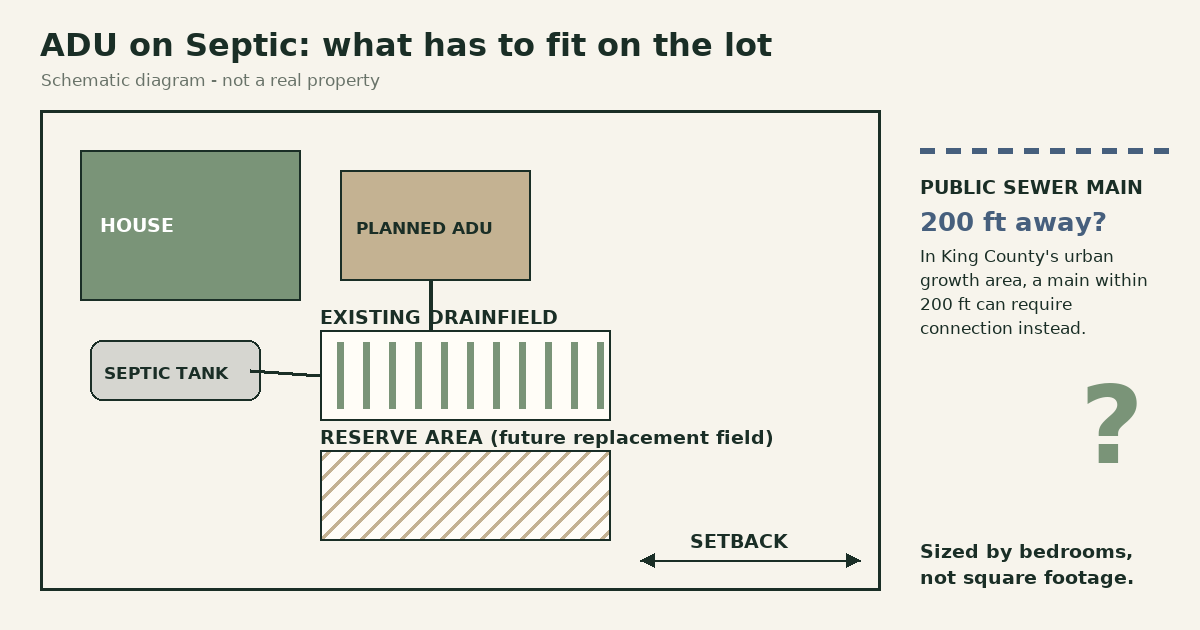
Yes — in most of King and Pierce County you can build an ADU on a septic system, but only if that system, or an upgrade to it, can handle the extra bedrooms. Health departments size septic systems by bedroom count, not square footage, so a 400 sq ft one-bedroom ADU and an 800 sq ft one-bedroom ADU are the same project in their eyes. There are two common deal-breakers: a lot with no room left for a larger drainfield and its reserve area, and — inside King County's urban growth area — a public sewer within 200 feet that you may be required to connect to instead.
This guide covers how the bedroom math works, what each county's health department actually requires, the costs you can check today, and what to find out before you spend a dollar on plans.
What decides whether your septic system can support an ADU?
One number: bedrooms. Washington's on-site sewage rule sets residential design flow at 120 gallons per day per bedroom (an operating capacity of 90 gallons with a 33 percent surge factor), with a minimum of 240 gallons per day per dwelling (WAC 246-272A-0230, accessed Aug 2026). When two dwellings share one system — a house plus an ADU — the rule is explicit: the first dwelling counts at a minimum of 240 gallons per day, and each additional dwelling adds 120 gallons per day per bedroom.
So a 3-bedroom house on a system designed for 3 bedrooms has zero spare capacity on paper. Add a 1-bedroom ADU and the system must now be approved for the equivalent of 4 bedrooms' flow — which usually means a formal review, and often a larger tank, an expanded drainfield, or a different treatment technology.
Three things follow from the bedroom rule:
- A studio still counts. Health departments count sleeping capacity, not marketing labels. Plan on a studio being reviewed as a one-bedroom, and confirm with your reviewer.
- Square footage is almost irrelevant to the septic question. Where your lot's size matters is the drainfield: the soil area for the existing field, any expansion, and the required reserve area all have to fit with setbacks.
- You cannot trade bedrooms informally. Converting a house bedroom to an office while adding an ADU bedroom may keep the total the same, but that is a determination the health department makes during review — not one you can assume.
How does King County handle an ADU on septic?
King County wrote the ADU scenario directly into its code. Board of Health Code Title 13 states that when an accessory dwelling unit is connected to an existing on-site sewage system, "each bedroom in an accessory dwelling unit... shall be included in the total number of bedrooms to be served by the OSS in addition to the bedrooms in the primary residence" (King County BOH Code 13.28.030.M, code updated June 11, 2025; accessed Aug 2026). There is no ambiguity: the ADU's bedrooms stack on top of the house's.
The county also defines what counts as an "expansion": any change where a building's occupancy potential increases, or the number of bedrooms increases, such that the system would be loaded beyond its existing treatment or disposal capability (BOH 13.08.142).
The sewer trap — check this before anything else. Inside the urban growth area, King County requires new construction to connect to a public sewer where the sewer utility permits it, and requires existing development to connect when the on-site system needs repair, modification, or replacement — or when "additional construction which in any way affects the on-site sewage system is proposed." The distance threshold is 200 feet from a public sewer line (BOH 13.04.050). An ADU is additional construction that affects the system. So if you are inside the UGA and a sewer main runs within 200 feet, your "ADU on septic" project may in fact be an "ADU plus sewer connection" project — a different budget and a different timeline.
The process. Public Health – Seattle & King County requires an approved Application for Health Department Approval of Proposed Building Project before you apply to the building department — health review comes first, not last. The county's guidance puts it plainly: number of bedrooms equals occupancy equals size of septic system, and if bedrooms are being added, call the county's septic line first (206-477-8177). As of this writing, PHSKC lists its OSS permitting review time at approximately 8 weeks, subject to staffing and volume (PHSKC, "House or building remodels or expansions," accessed Aug 2026). Build that into your schedule: eight weeks of health review before the building permit clock even starts.
Where does this actually come up? The City of Seattle is sewered — this is not a Seattle-city problem. It is a Vashon Island, rural east King County, and unincorporated-pocket problem, plus older neighborhoods at the sewer network's edges. Before any of it matters, check whether your lot qualifies for a DADU.
How does Pierce County handle an ADU on septic?
Pierce County is where septic ADUs are common rather than exceptional — large parts of Edgewood, Graham, Spanaway, the Key Peninsula, and the areas around Gig Harbor run on on-site systems.
Septic review here belongs to the Tacoma-Pierce County Health Department (TPCHD). For construction on a property with an existing system, TPCHD publishes Remodel Project Requirements (residential and commercial), and new or modified system designs go through its three-step process: submit a complete application with the system design and water availability for approval, then install under permit, then final inspection. Current charges are in TPCHD's 2026 fee schedule ("On-Site Individual Well and Water Resources Fees") — check the current schedule rather than any blog's numbers, including ours. TPCHD does not publish a standard review timeline for these projects; ask for the current estimate when you submit (TPCHD septic applications and forms, accessed Aug 2026; (253) 649-1925, ehsepticsystems@tpchd.org).
The bedroom math is the same state math — WAC 246-272A applies everywhere in Washington. What differs by county is process, fees, and how much room your soils leave you. On the Pierce side, our Tacoma ADU team sequences the health-department step with the building permit.
What does an ADU on septic actually cost?
Honest answer: the range is too wide for one number, because it depends on whether your existing system has capacity, your soil type, and whether you are upgrading, expanding, or replacing. Anyone quoting you a septic-upgrade price before soils and records review is guessing. Budget in three buckets:
- Records and review — county application and review fees, published in each county's current fee schedule (PHSKC and TPCHD both post theirs). This is the cheap bucket, low hundreds to low thousands.
- Design and soils work — a licensed OSS designer and, where needed, soil logs or monitoring. Get two quotes; this market is local and prices vary.
- Construction, if your system needs work — from "nothing, the system has capacity" to a full replacement with advanced treatment. This bucket is unknowable until buckets 1 and 2 are done, which is exactly why they come first.
And compare against the alternative honestly. If you are near a sewer line in King County, connecting is not free either: King County's sewer capacity charge for 2026 runs $77.99 per residential customer equivalent per month for 15 years, and an ADU is assessed at 0.59 RCE — about $46 a month, roughly $8,282 over the 15 years (King County Wastewater Treatment Division, 2026 rates; accessed Aug 2026) — before the cost of physically building the side sewer connection. Septic upgrade versus sewer connection is a real economic comparison, not a foregone conclusion in either direction. Our breakdown of site costs: sewer, power, and access covers the rest of the below-ground budget.
What should you do before hiring anyone?
- Pull your septic records. Both counties keep as-builts and permit history online — search "King County septic records" or "TPCHD septic records" and download what exists for your parcel. If there is no record, that is itself important information.
- Check the sewer map if you are in King County's urban growth area. A main within 200 feet changes the whole question (BOH 13.04.050).
- Count bedrooms the way a reviewer will: every room in the main house that could be a bedroom, plus every bedroom in the planned ADU.
- Find your tank lids and drainfield, and note the last pumping date. Wet spots over the field in August are a bad sign worth knowing early.
- Confirm reserve area. Your lot must also hold a designated reserve area for a future replacement field; a yard that is exactly big enough for the ADU plus the existing field, with nothing spare, is a red flag (WAC 246-272A reserve provisions).
Then get a feasibility read from people who do this weekly — a licensed septic designer for the OSS side, and a builder who knows how the health-department step sequences with the building permit. Our detached ADU construction page covers how we run that sequence.
Frequently Asked Questions
Can the ADU share the existing septic tank and drainfield?
Yes, if the review shows capacity for the combined bedroom count — Washington's rule explicitly covers multiple dwellings on one system (first dwelling 240 gpd minimum, each additional dwelling 120 gpd per bedroom, WAC 246-272A-0230). Many ADUs tie in; the review decides.
Do I have to connect to sewer if a line is nearby?
In King County's urban growth area, yes in most cases — within 200 feet, when the utility permits connection and your project counts as additional construction affecting the septic system (BOH 13.04.050). Outside the UGA and in most of Pierce County's septic areas, no.
If I convert a bedroom in the house, can I add an ADU bedroom without upgrades?
Sometimes — but that is the health department's call during review, not an assumption you can build on. King County defines expansion by occupancy potential, not just the raw count (BOH 13.08.142).
Does a composting toilet or greywater system get me out of the review?
No. Systems are sized by bedrooms, and alternative fixtures rarely change the bedroom count a reviewer uses. Ask your reviewer before spending money on this route.
How long does approval take?
King County currently lists about 8 weeks for OSS review, before your building permit review starts (PHSKC, accessed Aug 2026). TPCHD does not publish a standard timeline — ask when you submit.
Can soils testing happen in winter?
Often winter is the required window, not an obstacle: seasonal water-table monitoring has to be observed during the wet months. If your reviewer wants wet-season data, a summer start means waiting for it.
The bedroom rule cuts both ways. It kills some projects on paper in an afternoon — which is a cheap way to find out — and it clears others just as fast. We have built 93+ ADUs across King, Pierce, and Snohomish counties, including on septic, and the pattern is consistent: the projects that go smoothly are the ones where the health-department question was answered before the design was drawn, not after. If your parcel sits in Pierce County, also check the local envelope in Tacoma & Pierce County ADU rules. If your lot is on septic, start with a free site visit — we will pull your records, walk the yard, and tell you which of the three cost buckets you are actually in. (253) 332-9333.
Sources
- https://app.leg.wa.gov/WAC/default.aspx?cite=246-272A-0230
- https://kingcounty.gov/en/legacy/council/legislation/board-of-health-code
- https://kingcounty.gov/en/dept/dph/certificates-permits/septic-systems
- https://www.tpchd.org/healthy-homes/septic-systems/
- https://kingcounty.gov/en/dept/dnrp/waste-services/wastewater/rates-fees