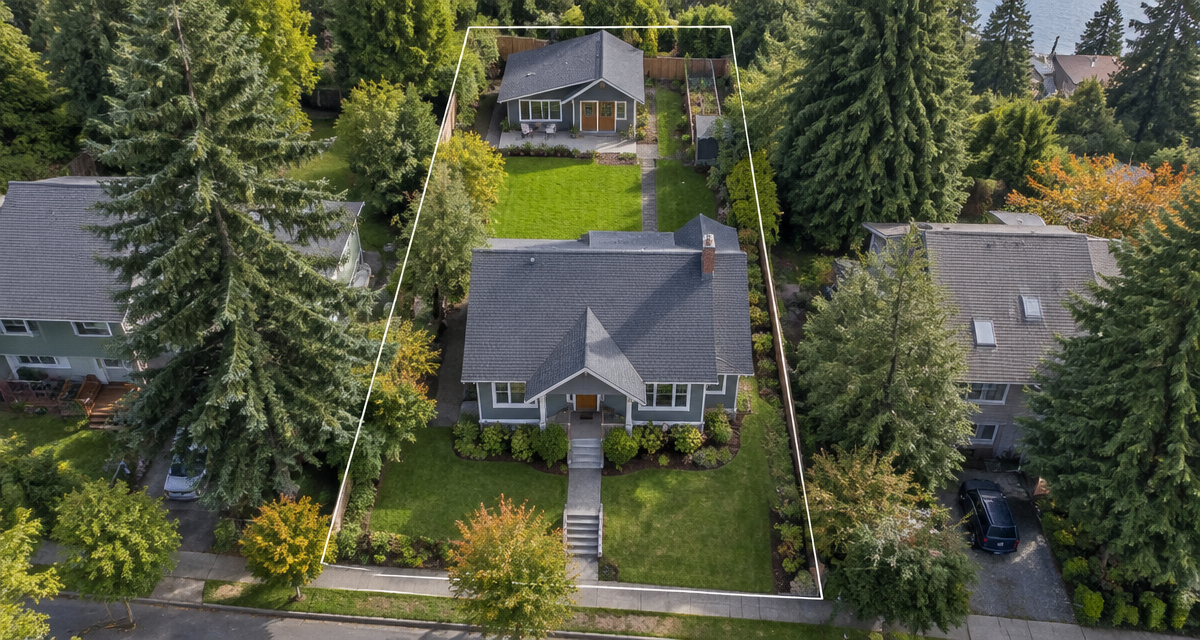
Quick answer: Most Seattle-area lots CAN host a backyard DADU — state law now guarantees the right to two ADUs per lot in urban growth areas — but five site factors decide whether yours pencils: lot size and coverage, setbacks, slope, sewer/utility capacity, and construction access. In Seattle that typically means a lot of roughly 3,200 sq ft or more, about 5-foot rear and side setbacks for the cottage, a workable path for equipment, and a side sewer with capacity to share. You can get an instant read on your specific parcel with our free Analyze My Lot tool — it checks zoning, lot size, and buildable area in about 60 seconds.
Key facts
- Washington guarantees two ADUs per lot in urban growth areas; cities can't require owner-occupancy or cap size below 1,000 sq ft.
- Seattle baseline: roughly 3,200+ sq ft lot, DADU up to 1,000 sq ft (or a share of lot/primary-home size), ~5 ft rear/side setbacks, up to 24 ft height — two-story cottages are in.
- Slope is a cost dial, not usually a veto: gentle grades add foundation work; very steep or environmentally critical areas need engineering (and sometimes kill the project).
- Sewer is the silent decider: side-sewer condition, capacity, and the length of the run to the cottage move the budget more than finishes do.
- Access matters for construction: a ~8–10 ft path for equipment makes everything cheaper; site-built construction doesn't need a crane, so tight urban backyards that prefab trucks can't reach are still buildable.
- Fastest check: Analyze My Lot (free, ~60 seconds) → then a human site evaluation confirms sewer, slope, and access before you spend a dollar on design.
Factor 1 — Lot size, coverage, and where the cottage can sit
The first math is simple footprint math: your zone's lot-coverage and rear-yard rules define a buildable envelope, and the DADU (plus required separation from the main house) has to fit inside it. Seattle's reforms made this generous — up to 1,000 sq ft of cottage and 24 feet of height mean a two-story, two-bedroom DADU fits on lots that would have failed five years ago. Corner lots and alley lots often have the friendliest envelopes of all. For the footprint arithmetic itself — coverage budget, buildable width, and which plan sizes fit — see DADU floor plans by lot size; this page stays on whether the site works at all.
Factor 2 — Setbacks and the neighbors' airspace
Typical Seattle DADU setbacks run about 5 feet from rear and side property lines, with alley frontage often earning bonuses. The trap isn't the number — it's what's already inside it: existing sheds, mature trees, easements, and overhead service drops all shrink the real envelope. This is exactly what a site plan (or our lot tool's parcel overlay) reveals in minutes.
Factor 3 — Slope: a budget dial, occasionally a veto
Flat lot: standard foundation, best price. Gentle slope: stepped footings or a short retaining wall — thousands, not deal-breakers. Steep slope: engineered foundations, drainage design, and — if the grade crosses into an environmentally critical area (steep-slope, wetland, or riparian buffers) — extra review that can constrain or occasionally kill a project. The honest rule from 93+ builds: slope changes the number far more often than it changes the answer.
Factor 4 — Sewer, water, power: the invisible half of the budget
Every DADU needs water, sewer (or septic capacity in unincorporated Pierce County), and power. Three questions decide this factor: Is your side sewer sound and deep enough to serve the backyard by gravity? How long are the trench runs from street or house to cottage? Does your electrical panel have capacity (200-amp panels usually do; 100-amp often means an upgrade)? None of these are visible from the kitchen window — which is why our site evaluation walks the actual utility path before design begins.
Factor 5 — Access: can we build it without wrecking the yard?
Site-built DADUs need a working corridor — ideally 8–10 feet — for excavation and materials. Alley access is gold; a side-yard gate path works; a fully landlocked backyard means hand-carry logistics that add cost. What you do NOT need is a crane or a clear truck path to the backyard — that's a prefab constraint, and it's the reason many tight Seattle lots that prefab companies decline are perfectly buildable site-built.
Check your lot in 60 seconds — free
You could spend an afternoon with the municipal code — or let the tool do it. Analyze My Lot pulls your parcel, checks zoning and lot size, maps the rough buildable area, and gives you a feasibility read with a cost range in about a minute, free.
The 60-second first step, then a human
Green light on the tool → we confirm the physical factors (sewer, slope, access) with an on-site evaluation, then quote a fixed price covering design, permits, and construction. If your lot genuinely doesn't pencil, we'll tell you that too — and what alternative (a garage conversion or basement ADU) might.
Frequently Asked Questions
What's the minimum lot size for a DADU in Seattle?
Roughly 3,200 sq ft is the practical baseline in most Seattle single-family zones, with the cottage size governed by lot coverage and a 1,000 sq ft cap. Smaller lots sometimes still work — the envelope math is exactly what our free Analyze My Lot tool checks.
Can I build a DADU on a sloped lot?
Usually yes. Gentle slopes add foundation and drainage cost; steep slopes need engineering; only environmentally critical areas (very steep grades, wetlands, buffers) regularly stop projects. Slope moves the price more often than the verdict.
What if my lot is on septic instead of sewer?
Common in unincorporated Pierce County. The septic system must have (or be upgraded to) capacity for the additional dwelling — a health-district review we handle as part of feasibility.
Do I need street or alley access to build?
No. An 8–10 ft working path is ideal, alley access is best, but site-built construction needs no crane or truck lane to the backyard — tight urban lots that prefab can't serve are routinely buildable.
Do trees on my lot block a DADU?
Sometimes they shape it. Seattle's tree protections can constrain the footprint around significant trees; more often the design shifts a few feet rather than dies. It's a site-plan question, answered early.
What's the fastest way to check my specific lot?
Run it through Analyze My Lot (free, about 60 seconds) for zoning, size, and buildable-area checks — then book a free site evaluation and we'll verify sewer, slope, and access on the ground.
Your lot's DADU verdict comes down to five factors — and four of them are usually cost dials, not stop signs. Start with the free Analyze My Lot tool for a 60-second read on zoning and buildable area, then book a site evaluation and we'll walk sewer, slope, and access with you. If your parcel sits in south Pierce County, also see renting to JBLM military families for the near-base rental playbook. Hiring next? See ADU builders near me: how to choose locally. Related reading: the 2026 Washington ADU laws, what a DADU costs in Seattle, the King County DADU permit process, and garage conversion vs new DADU.