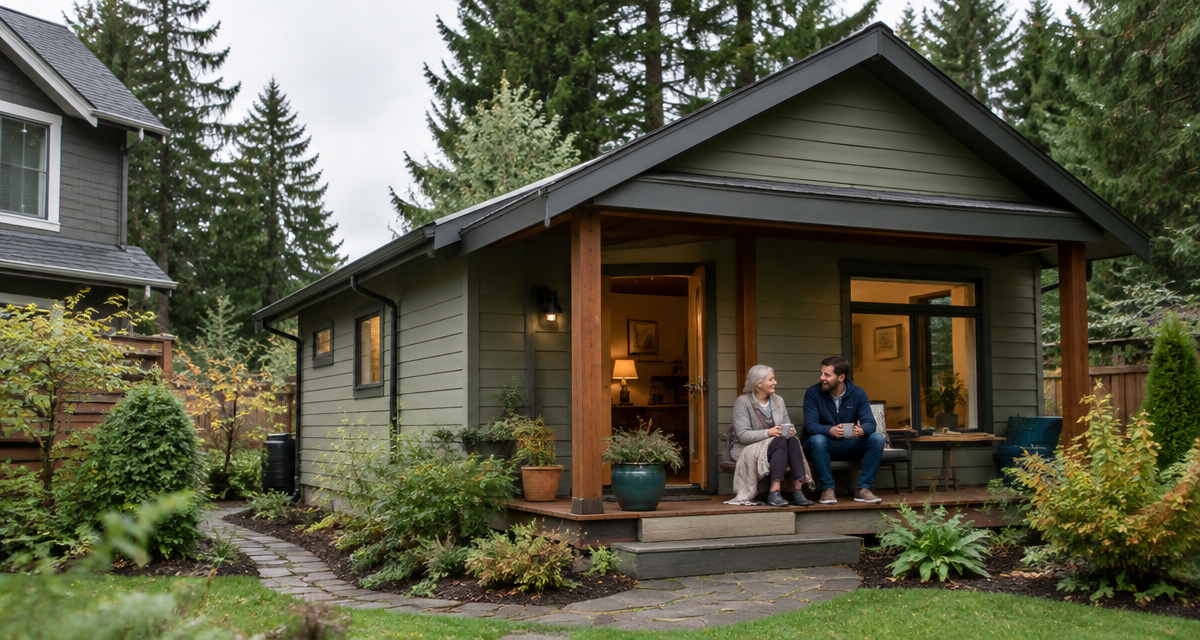
Quick answer: Assisted living in the Seattle area commonly costs $7,000–$9,000+ per month — $85,000–$110,000 a year that's gone forever. A detached backyard ADU (DADU) costs $250,000–$450,000 once, keeps your parents thirty steps away instead of thirty minutes, and typically offsets the cost of a facility within 3–4 years — after which the cottage keeps working as family housing, rental income, or resale value. For many Puget Sound families, it's not just the warmer choice; it's the better balance sheet.
Key facts
- Seattle-area assisted living: commonly $7,000–$9,000+/month; memory care runs higher. (Verify current local rates — they rise yearly.)
- DADU build cost: $250,000–$450,000 one-time; the asset appreciates with your property.
- Break-even vs a facility: typically ~3–4 years — then the ADU is a paid-for asset, not a bill.
- Washington law allows two ADUs per lot with no owner-occupancy requirement — parents in the DADU changes nothing about your rights.
- Aging-in-place design costs little when planned from day one: zero-step entry, wider doorways, curbless shower, lever handles, good lighting.
- When the season of care ends, the same cottage becomes $1,600–$2,800/month in rental income or multigenerational space for the next generation.
The math families avoid doing out loud
Nobody wants to reduce Mom to a spreadsheet — but the spreadsheet is exactly why this decision deserves daylight. Five years of assisted living at Seattle-area rates is roughly $425,000–$550,000, gone. Five years after building a $350,000 DADU, you've spent less — and you own a permitted second dwelling on your land. One path is rent; the other is equity with a front porch.
What you're really buying: proximity with dignity
An ADU solves the problem facilities can't: independence and closeness at once. Parents keep their own kitchen, their own door, their own routine — you keep dinner together, grandkids across the yard, and the ability to help in ninety seconds instead of a ferry of phone calls. It's a full legal dwelling, not a spare room: private, self-sufficient, and built around their next fifteen years, not their last address.
Design it for the next fifteen years, not the first
Aging-in-place details are nearly free at the design stage and expensive to retrofit: a zero-step entry and level thresholds; 36-inch doorways; a curbless walk-in shower with blocking in the walls for future grab bars; lever handles instead of knobs; rocker light switches; brighter, layered lighting; and a bedroom-bath layout that works for a walker before one is needed. We fold these into the plan by default on family builds — the cottage should outlast the season it was built for.
One build, three lives
This is the quiet advantage over every other eldercare option: the building doesn't retire when its first mission ends. The same DADU serves as (1) parents' home today, (2) long-term rental at Seattle–Tacoma market rents of roughly $1,600–$2,800/month tomorrow, and (3) a first home for an adult child — or a resale selling point — after that. Washington law even allows an ADU to be sold as a condominium unit. Facilities charge rent; an ADU builds a position.
The honest caveats
An ADU is not a nursing substitute: when care needs cross into round-the-clock medical territory, a facility or in-home care layered onto the ADU is the right call. Your lot must qualify (utilities, access, setbacks), the build takes 10–16 months — so start before the need is urgent — and family finances deserve the same clear agreement as any construction contract: who pays, who owns, what happens later. We've walked 93+ families through those exact questions.
Frequently Asked Questions
Is building an ADU cheaper than assisted living?
Over time, usually yes. Assisted living near Seattle commonly runs $7,000–$9,000+ per month with nothing owned at the end; a $250,000–$450,000 DADU typically offsets facility costs within 3–4 years and remains a family asset afterward.
Can my parents live in an ADU on my property in Washington?
Yes. State law guarantees at least two ADUs per lot in urban growth areas, with no owner-occupancy requirement — family use is the simplest case of all.
What design features matter for an aging-parent ADU?
Zero-step entry, wider doorways, a curbless walk-in shower with blocking for future grab bars, lever handles, strong lighting, and a single-level layout. Planned upfront, they add little cost.
How long does it take to build?
Plan on roughly 10–16 months end to end — design, permitting, and construction. Start the conversation before the need becomes urgent.
What happens to the ADU later?
It keeps earning: long-term rental (typically $1,600–$2,800/month in the Seattle–Tacoma market), housing for adult kids, or added resale value — and Washington law allows ADUs to be sold as condominium units.
An ADU for aging parents is a rare decision where the warm answer and the financial answer point the same direction. If you're weighing a facility against a backyard cottage, book a free feasibility review — we'll map your lot, quote a fixed-price design-permit-build path, and help you frame the family conversation. Related reading: what a DADU actually costs, the Seattle permit process, ADU rental income, the 2026 Washington ADU laws, and who pays, who owns: the family money questions.