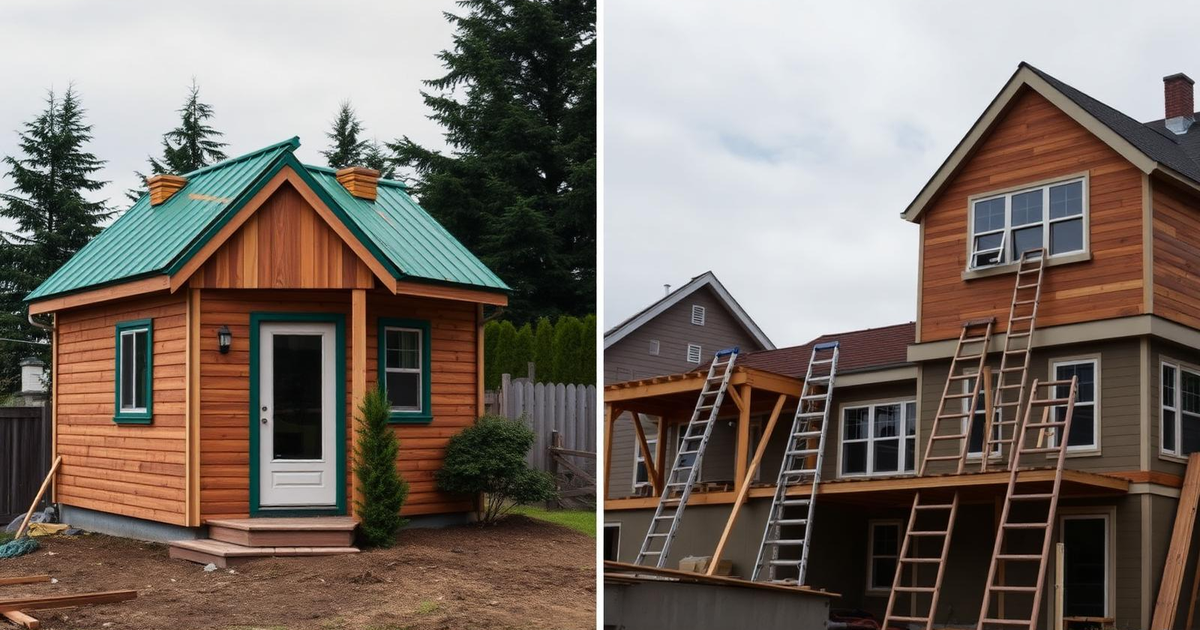
Quick answer: There are five realistic ways to get an ADU built in the Puget Sound, and they are not equally good bets. An ADU specialist (design + permits + build under one fixed price) fits most detached cottage projects, because a DADU is 20% construction and 80% navigating a second-dwelling permit through your specific city. A general contractor you already trust can be the right call for basement or attached conversions, or when the ADU rides along with a bigger remodel. A prefab vendor wins on flat, truck-accessible lots where speed matters most. An architect plus separate builder buys design freedom and costs coordination. And being your own general contractor saves a management fee while transferring permit liability, lien exposure, and warranty risk onto you — the option that goes wrong most often. Below: what each path really costs, and how to tell which one your project is.
Key facts
- A detached ADU is a legal second dwelling: its own permit path, utility connections, sometimes its own address and meters. That paperwork — not the framing — is what separates specialists from generalists.
- Typical all-in pricing here: conversions $85,000–$160,000 · detached cottages $185,000–$320,000 · premium custom $320,000+, with most detached DADUs landing $250,000–$450,000.
- Realistic timeline is 10–16 months end to end (feasibility, design, engineering, permitting, construction). Construction is often only 5–7 months of that.
- Design-build (one contract) vs split contracts: one contract gives one accountable party and a fixed price; architect-plus-builder gives design freedom, and you own the coordination between them.
- Owner-as-GC means permits pulled in your name, code liability on you, subcontractor lien exposure against your home, and no single warranty chain — lenders and appraisers also treat owner-built work more cautiously.
- The honest filter that beats any label: how many ADUs has this company actually finished, and in which jurisdictions? (For reference: we've completed 93+ across King, Pierce, Snohomish, and Thurston counties.)
The five paths, side by side
| Who you hire | Best for | Cost effect | Main risk you carry |
|---|---|---|---|
| ADU specialist (design-build) | Detached cottages; owners who want one price and one accountable party | Fixed price covering design, permits, build | Fewer — the specialist owns permitting and schedule |
| Trusted general contractor | Basement/attached conversions; ADU bundled with a remodel | Comparable, if they've done ADUs before | Learning your city's second-dwelling path on your calendar |
| Prefab / modular vendor | Flat lots with crane and truck access; speed priority | Module price looks low; site work, utilities, foundation, crane are separate | Site-work surprises and access limits |
| Architect + separate builder | Highly custom designs, unusual lots | Design fees on top; two contracts to coordinate | Coordination gaps and change-order friction land on you |
| You as general contractor | Experienced builders only | Saves a management fee | Permit liability, lien exposure, no warranty chain, financing friction |
Not sure which path fits? Check your lot in 60 seconds — free — with Analyze My Lot, or call (253) 332-9333 (tap to call).
Vendor-type comparison: ADU company vs general contractor vs owner-as-GC
The three most common paths for a detached ADU — side by side on the nine things that actually decide budget, calendar, and who eats a surprise.
| What to compare | ADU company (design-build) | General contractor | Owner as GC |
|---|---|---|---|
| Scope | Design + permits + construction under one contract | Construction; sometimes design if paired with an in-house or partner architect | Construction only; you assemble every other piece |
| Who owns permitting | The specialist — pulls in their name, manages corrections and inspections | The GC, if experienced with ADUs in your jurisdiction | You — permits pulled in your name, code liability on you |
| Who draws plans | In-house or long-standing partner architect used to your city's ADU rules | Separate architect you hire, or the GC's partner | You hire the architect and coordinate revisions |
| Subs management | Specialist's regular crews and long-term trade partners | GC's trade roster (may or may not include ADU-specific subs) | You hire, schedule, and pay each sub directly |
| Timeline | 10–16 months end-to-end, priced against a real permit calendar | 10–16 months if ADU-experienced; longer while learning the desk | Highly variable; often extends when subs take bigger jobs mid-project |
| Cost structure & markup | Fixed price covering design, permits, and construction; markup baked into one number | Cost-plus or fixed price on construction; design and permits are separate line items | No management markup; you pay each vendor, plus your own time |
| Change-order risk | Lower — one team owns scope; written exclusions up front | Moderate — depends on how tight the plans and specs were drawn | Highest — every scope gap between subs is yours to resolve |
| Warranty | Single warranty chain covering the whole build | GC warrants construction; design defects sit with the architect | No unified warranty — each trade warrants only its own piece |
| Best fit | Detached DADUs, first-time ADU owners, anyone who wants one accountable party | Owners with a trusted, ADU-experienced GC or an ADU bundled into a larger remodel | Experienced builders only |
Why ADUs punish generalists
A kitchen remodel lives inside an existing legal structure. An ADU creates a new one — and that changes which skills matter. The work that decides an ADU's budget and timeline happens where most remodelers rarely go: getting a second dwelling through your jurisdiction's review (Seattle's SDCI process, Tacoma's, unincorporated Pierce County's health-district path for septic, Thurston County's own rules), running water, sewer, and power across a yard without wrecking it, staging construction on a lot with no room, and passing inspections for a unit that needs its own address and sometimes its own meters. A good general contractor can build a beautiful cottage. The question is whether they've already learned your city's ADU review — or will learn it while your permit sits.
When a general contractor is genuinely the right choice
Three honest cases. One: you already have a GC you trust who has finished ADUs — relationship plus relevant experience beats a specialist you don't know. Two: the project is a basement or attached conversion inside a larger remodel, where the ADU is one workstream among many. Three: the scope is small and local rules are simple in your jurisdiction. In those cases, ask the same ADU-specific questions you'd ask us — how many they've completed, which permit desks, and whether the price is fixed with written exclusions.
When prefab makes sense — and when it can't reach your lot
Prefab wins where its constraints are satisfied: a flat, wide lot with a clear path for delivery trucks and a crane, and a schedule that values factory speed. What surprises owners is the quote structure — the module is one line item, while foundation, site prep, utility trenching, crane, and finish work arrive separately. Site-built construction needs no crane and no truck lane, which is why tight urban backyards that prefab companies decline are routinely buildable. We break the method comparison down in detail in our prefab vs site-built guide.
The owner-as-GC trap
The math looks appealing: skip the management fee, hire subs directly, keep the difference. What actually transfers to you: permits in your name (code liability included), lien exposure if a sub you paid didn't pay their supplier, no single warranty — each trade warrants only its own piece, schedule risk when a sub takes a bigger job mid-project, and financing friction, since lenders and appraisers scrutinize owner-built dwellings. Homeowners who do this well are usually builders themselves. Everyone else discovers that the fee they saved was the price of someone else carrying all of the above.
How to compare whoever you shortlist
Five filters that work on any vendor type: (1) How many ADUs have you completed, and in which cities? (2) Is this a fixed price, and what's excluded in writing? (3) Who pulls the permits? (4) What's the end-to-end timeline, and what typically delays it here? (5) Are payments tied to completed milestones? If you're comparing local options by proximity as well, our local-search guide covers what "near me" should actually mean for a cottage build. For cost context by tier, see what an ADU actually costs in Seattle. And before you shortlist anyone: confirm your parcel works — Analyze My Lot returns zoning, size, and buildable-area answers in about 60 seconds, free. Details of the physical checks are in our lot-qualification guide; if a full new cottage doesn't pencil, a garage conversion sometimes does.
Ready when you are
Two free starting points: run Analyze My Lot for an instant feasibility read, or call (253) 332-9333 and book a site evaluation — we walk the yard, confirm the utility path, and hand you a fixed price covering design, permits, and construction. If a different path fits your project better — your own GC, or a conversion instead of a new cottage — we'll say so.
Frequently Asked Questions
Should I hire an ADU company or a general contractor?
For a detached ADU, a specialist usually wins: the project hinges on permitting a second dwelling, running utilities across a yard, and small-lot logistics. A trusted general contractor is a strong choice for basement or attached conversions, or when the ADU is part of a larger remodel — provided they've finished ADUs before.
Are ADU companies more expensive than general contractors?
Not inherently. Specialist pricing typically bundles design, engineering, permits, and construction into one fixed number, which can look higher than a construction-only estimate that excludes permits and design. Compare full scope, not headline figures.
Can any general contractor build an ADU in Seattle?
Legally, any registered contractor can. Practically, the difference shows in permit review: a builder who submits ADU plans in your jurisdiction regularly clears corrections faster than one learning the process on your project.
Is prefab cheaper than a local ADU builder?
The module price often looks cheaper, but foundation, site prep, utility trenching, crane, permits, and finish work are usually separate. Prefab also needs truck and crane access — a constraint that rules out many Seattle backyards.
Can I be my own general contractor for an ADU in Washington?
Yes, and it shifts permit liability, subcontractor lien exposure, schedule management, and warranty coordination to you, with lenders and appraisers treating owner-built dwellings more cautiously. It works for experienced builders and rarely for anyone else.
How do I compare ADU companies near me?
Ask every candidate the same five questions — completed ADU count and cities, fixed price with written exclusions, who pulls permits, honest end-to-end timeline, and milestone-based payments — then compare the answers, not the totals.
The label matters less than the filters. Whichever path you shortlist — specialist, trusted GC, prefab, architect-plus-builder, or owner-GC — the same five questions expose fit: completed ADU count and cities, fixed price with written exclusions, who pulls permits, honest end-to-end timeline, and milestone-based payments. Start with the free Analyze My Lot tool, then call (253) 332-9333 to book a free site evaluation. Related reading: the local-search hiring guide, prefab vs site-built, what an ADU costs in Seattle, and will your lot qualify for a DADU.