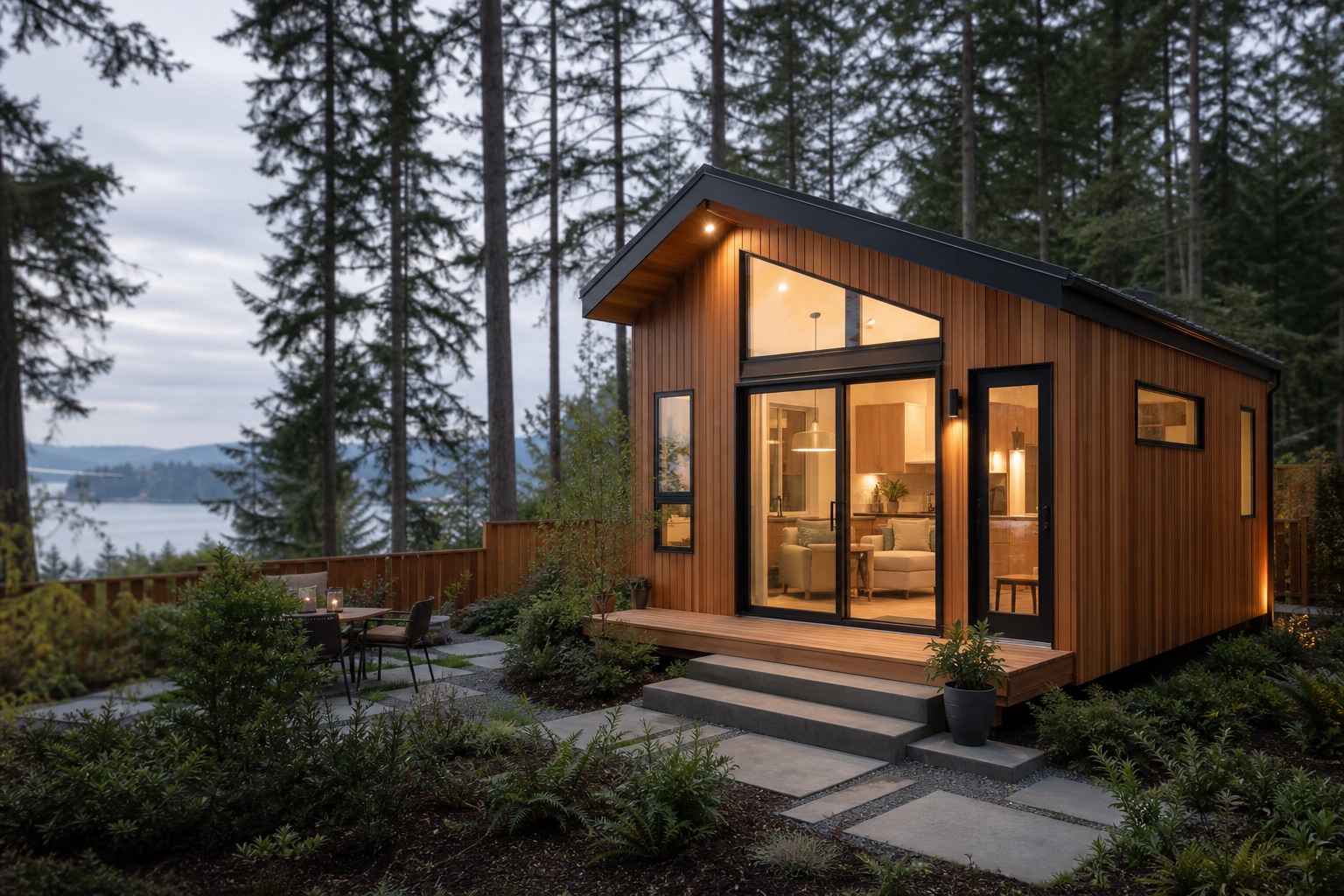
Backyard building in the Puget Sound is changing faster in 2026 than at any point since HB 1337 passed. After permitting 60+ ADUs and DADUs across Seattle, Tacoma, Bellevue, Kirkland and unincorporated King County in the last 18 months, here are the seven trends our team is seeing in nearly every new project — and what each one means for homeowners weighing a build this year.
1. Prefab and Panelized DADUs Are Finally Cost-Competitive
Factory-built DADU shells from Washington manufacturers (Node, Method, NorthStar, and a handful of Tacoma-based panelizers) now land on site for roughly 8-14% less per square foot than equivalent stick-built DADUs, with framing-to-dry-in cycles of 3-5 days instead of 4-6 weeks. The catch in Seattle's wet-season permitting reality: prefab still needs the same foundation, utility separations, and DCI review, so total project timelines compress by about 6-10 weeks, not 6 months.
Where prefab wins in 2026: flat lots in Tacoma, Lakewood, and unincorporated Pierce County, where crane access is easy. Where it still loses: sloped Seattle lots in Phinney Ridge, Madrona, and West Seattle, where a custom stick-built foundation often costs less than the prefab delivery and crane combined.
2. AI-Generated Floor Plans Are Cutting Design Time in Half
Generative AI tools (Maket, ARK, and several in-house architect workflows) are now producing first-pass DADU floor plans in hours instead of weeks. AI is not replacing architects — every plan still needs a licensed stamp for permit — but schematic design fees are dropping from $6,000-$12,000 to $2,500-$5,000 on standard 600-900 sq ft builds.
The bigger win for homeowners: AI-driven option generation. Where a client used to see 2 layouts, they now see 6-10 — and the final design fits the lot, the budget, and the rental strategy much more tightly. Expect this to be standard on every Puget Sound DADU project by the end of 2026. The same AI shift is now showing up on the permit side too — see our breakdown of AI permit pre-screening for Seattle, Tacoma & Bellevue DADUs in 2026, which is cutting King County permit timelines by roughly 40%.
3. Sub-500 Sq Ft 'Micro' ADUs Are the Fastest-Growing Category
Seattle and Tacoma both fast-track ADUs under 500 sq ft with reduced parking, setback, and SEPA requirements. In 2026 these micro units — typically 1-bed, 1-bath studios at 380-480 sq ft — are the single fastest-growing permit category in King County, up roughly 40% year over year per DCI data.
Build cost lands at $185,000-$240,000 turnkey in Seattle, and they rent for $1,650-$2,200/month — a 9-11% gross yield that beats almost every larger DADU. The trend is being driven by empty-nesters who want rental income without committing a full backyard, and by adult children moving home.
4. Sell-Separately DADUs Are Now a Real Exit Strategy
HB 1337 plus the unit-lot subdivision reforms now in force across Seattle, Bellevue, Tacoma and unincorporated King County mean a backyard DADU can be platted, titled, and sold as a standalone home. Closings above $475,000 are routine in Seattle, above $625,000 in Bellevue. Roughly 1 in 5 new DADU clients now ask about the sell-separately option before breaking ground — up from near zero in 2024.
The trend changes design choices upstream: separate utilities from day one, independent address-ready siting, and resale-grade finishes instead of landlord-grade.
5. Heat-Pump-First, All-Electric Builds Are the Default
Washington's 2024 energy code update effectively eliminated gas furnaces in new ADU construction, and 2026 is the first year where 100% of our DADU permits are all-electric: heat-pump space heating, heat-pump water heaters, induction cooktops. Operating cost lands at roughly $1,800-$3,200 per year for a 750 sq ft DADU in Seattle — about 35% cheaper to run than the gas-and-resistance builds we were doing in 2022.
Bonus: PSE and Seattle City Light rebates now cover $2,000-$4,500 of the heat-pump package on most builds, and the federal 25C credit adds another $2,000 for qualifying systems.
6. Climate-Resilient Detailing — Wildfire Smoke, Heat, and Atmospheric Rivers
After the 2023 and 2025 wildfire smoke seasons and 2024's record atmospheric-river rainfall, Puget Sound homeowners are spec'ing MERV-13 ERVs, operable exterior shades, deeper roof overhangs (24-30 inches), and rainscreen siding on nearly every new DADU. None of these were standard in 2022; in 2026 they are on roughly 80% of our project specs.
The cost premium is modest — $4,500-$9,000 on a typical 700 sq ft DADU — and it future-proofs the unit for both rental marketability and resale.
7. Two-DADUs-Per-Lot Stacking Is the New Frontier in Tacoma and Bellevue
HB 1337 lets most urban lots in Washington support two ADUs. Tacoma and Bellevue are the first Puget Sound cities where we are seeing this play out at scale — typically one attached ADU (basement or above-garage) plus one detached DADU on the same parent lot.
Combined rental income on a stacked build runs $3,800-$5,400/month in Tacoma and $5,200-$7,200 in Bellevue. Build cost is roughly 1.6x a single DADU because the second unit shares site work, utilities, and design. Payback periods of 9-12 years are common.
Which Trend Should You Actually Care About?
If you want speed and a known budget: prefab plus a sub-500 sq ft footprint. If you want maximum long-term value: full-size DADU with sell-separately detailing and all-electric mechanicals. If you want maximum income from a single property: two-unit stacking on a qualifying lot. Every one of these paths is permittable today in 2026 across King, Pierce, and Snohomish counties — the right choice depends on your lot, your goals, and your time horizon.
Frequently Asked Questions
What are the biggest ADU trends in the Puget Sound in 2026?
Prefab and panelized DADU shells becoming cost-competitive, AI-assisted floor plans cutting schematic design fees, sub-500 sq ft micro ADUs growing fastest, sell-separately DADUs, all-electric heat-pump builds, climate-resilient detailing, and two ADUs stacked on one lot.
Are prefab DADUs actually cheaper in 2026?
Factory-built shells land on site for roughly 8–14% less per square foot than equivalent stick-built DADUs, with framing-to-dry-in in days instead of weeks. Foundations, utility separations, and city review are unchanged, so total timelines compress by weeks, not months.
Can you build two ADUs on one lot in Washington?
HB 1337 lets most urban lots in Washington support two ADUs — commonly one attached unit plus one detached DADU. Tacoma and Bellevue are the first Puget Sound cities where we see this at scale, with build cost around 1.6× a single DADU because site work and utilities are shared.
The Puget Sound ADU market in 2026 is no longer one product — it is six or seven distinct strategies, each with its own cost, timeline, and ROI. Book a free feasibility review and we will tell you which trend actually fits your backyard.