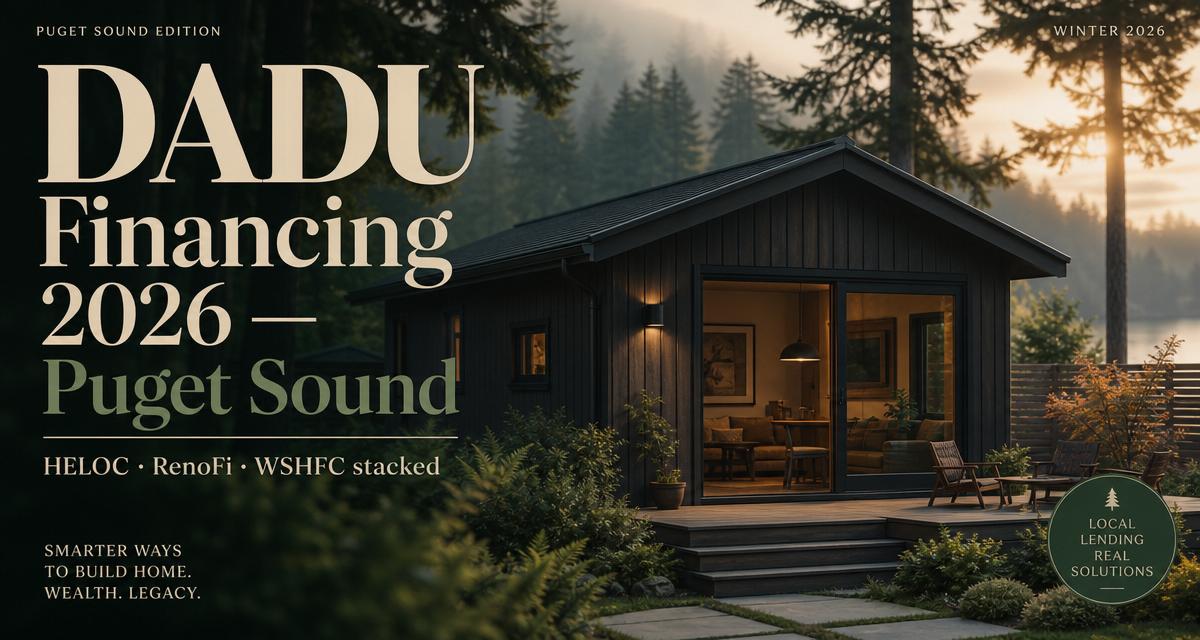
TL;DR. Most Puget Sound homeowners aren't paying cash for a $220K–$320K DADU — they're stacking 2–3 financing products. In 2026 the winning combo for Seattle, Tacoma and Bellevue projects looks like: a HELOC from BECU or Sound Credit Union (prime + 0%, ~7.75–8.50% APR) for soft costs and the down-payment phase, a Fannie Mae HomeStyle or RenoFi loan sized to the after-completion appraised value for the construction draw, and — when household income qualifies — a WSHFC Covenant Homeownership or House Key ADU layer for down-payment or rate relief. This guide breaks down real 2026 rates from local lenders, which stack works for each city (King vs Pierce County), and the break-even math against rental income.
Why DADU Financing Is Different From a Regular Home Loan
A detached ADU isn't a separate parcel — it sits on your existing lot, under your existing mortgage. That means most homeowners can't get a standalone construction loan against the DADU alone; lenders underwrite against the combined property value after the DADU is built. In 2026 this matters more than ever because Puget Sound home values are up but inventory is tight, and lenders have fully priced ADUs into their appraisal models.
Three financing structures dominate in 2026 for Seattle, Tacoma, Bellevue, Renton and Kent: (1) equity-tap products like HELOCs and cash-out refis that pull from your current equity, (2) renovation loans like Fannie Mae HomeStyle, Freddie Mac CHOICERenovation, and RenoFi that underwrite to the future appraised value, and (3) state-backed programs like WSHFC's House Key and Covenant Homeownership that stack down-payment assistance on top. Most of our clients combine two of these.
Real 2026 Rates from Puget Sound Lenders
| Product | Local Lender | 2026 Rate (APR) | Max Amount | Best For |
|---|---|---|---|---|
| HELOC (variable) | BECU (Tukwila HQ) | Prime + 0.00% — ~7.75% | 90% CLTV, up to $500K | Soft costs, design, permits |
| HELOC (variable) | Sound Credit Union (Tacoma) | Prime + 0.25% — ~8.00% | 85% CLTV, up to $400K | Pierce County builds |
| HELOC (variable) | WSECU (Olympia/statewide) | Prime + 0.50% — ~8.25% | 80% CLTV, up to $350K | Lower-equity homes |
| Cash-out refi (30-yr fixed) | BECU / Guild Mortgage | ~6.75–7.25% | 80% LTV combined | Locking rate, larger draws |
| Fannie Mae HomeStyle Reno | Guild, Caliber, Movement | ~7.25–7.75% | After-completion value, 95% LTV | Full $250K+ DADU build |
| RenoFi Loan (2nd lien) | RenoFi-network credit unions | ~9.25–10.50% | Up to 90% of after-reno value | High-equity needed, fast close |
| WSHFC House Key ADU | WSHFC-approved lenders | Below-market 1st lien | Income-tested, statewide | First-time-builder homeowners |
| WSHFC Covenant Homeownership | WSHFC + partner lenders | DPA up to $150K | Race-based + income-tested (King, Pierce, Snohomish, etc.) | Eligible Washington households |
Rates surveyed June 2026. APRs vary by credit, CLTV, and occupancy. Always confirm with the lender.
The 3 Most Common Stacks We See in 2026
Stack #1 — The Seattle/Bellevue Equity Stack. Homeowners in West Seattle, Ballard, Wallingford, Bellevue's Bridle Trails, and Kirkland often have $400K+ in tappable equity. They pair a BECU HELOC ($150K–$250K) for design + permits + the first construction draw with a HomeStyle refi at completion to roll everything into a single 30-yr fixed. Net rate after stabilization: ~7.0–7.4%. Works great when current first mortgage is above 6.5% anyway.
Stack #2 — The Tacoma/Pierce County Renovation Stack. Tacoma North End, Proctor, Eastside, and unincorporated Pierce County homeowners typically have less raw equity but strong income. They lead with a Fannie Mae HomeStyle from Guild Mortgage sized to the after-completion value, eliminating the need for a separate HELOC. Sound Credit Union sometimes provides a smaller HELOC for furniture/landscaping after lease-up.
Stack #3 — The WSHFC + RenoFi Boost. When the appraisal comes in tight (common in Renton, Kent, Auburn, Federal Way), a RenoFi second lien pulls from the after-completion value, then a WSHFC House Key ADU layer covers down-payment assistance. Total monthly payment drops 12–18% vs straight cash-out — and the WSHFC funds don't have to be repaid until you sell or refinance.
City-by-City: What Works Best in Your Jurisdiction
Seattle (King County). High equity + high project cost (~$280K–$340K turnkey). Best stack: BECU HELOC → HomeStyle refi at completion. Pair with pre-approved ADUniverse plans to cut $10K+ in design fees that financing has to cover.
Bellevue / Kirkland / Redmond (East King). Highest appraised values in the region — RenoFi's after-completion model shines here. Many homeowners use the Seattle pre-approved plan strategy even though Bellevue has its own pre-approved catalog, because Bellevue's premium lots support larger 1,000 sq ft DADUs that rent for $2,800+/mo.
Tacoma (Pierce County). Lower lot values, lower SDC fees, and the most affordable build environment in the Puget Sound — see our budget ADU guide for sub-$150K builds. Sound Credit Union and WSECU are the dominant local HELOC lenders; Guild Mortgage's Tacoma branch is HomeStyle-fluent.
Renton & Kent (South King). Sweet spot for income-property math — moderate equity, moderate cost, strong rents (see our Puget Sound ADU rental income breakdown). RenoFi + WSHFC stacks dominate here because borrowers often don't have Seattle-level equity yet.
Snohomish County (Everett, Lynnwood, Mukilteo). Lowest impact fees in the region. A straightforward HomeStyle loan usually covers the entire project without needing a second lien.
Don't Forget the Rebate Stack — It Reduces Your Loan Amount
Every dollar in 2026 utility rebates is a dollar you don't have to finance. Seattle City Light, Puget Sound Energy, Tacoma Power, and Snohomish PUD are collectively offering up to $13,200 in heat-pump + electrification rebates for new DADUs — read our full heat-pump ADU rebate guide before locking your loan amount.
Combined with WSHFC down-payment assistance and the federal 25C tax credits, the effective financed cost of a $260K all-electric DADU in Seattle can drop to $232K–$240K — which moves the rent-to-payment ratio firmly into cash-flow-positive territory.
The Break-Even Math: When Does the Loan Pay for Itself?
Take a representative 2026 Seattle DADU: $290K all-in, financed as a $230K HomeStyle refi at 7.25% (30-yr fixed) layered on a $1,650/mo existing mortgage. Incremental monthly cost: ~$1,570 (P&I) + ~$180 (added taxes/insurance) = ~$1,750/mo.
Long-term rent for a new 1-bed DADU in Ballard, Wallingford, Capitol Hill, or West Seattle is currently $2,100–$2,650/mo (median $2,350 — see our Puget Sound rental income analysis). Net positive cash flow from month one: +$400 to +$600/mo, before tax depreciation benefits.
In Tacoma's North End and Proctor, a $185K budget DADU financed at ~$155K nets out to ~$1,060/mo, against $1,650–$1,950/mo rents — also cash-flow positive. The math fails fastest in Bellevue when borrowers stretch to 1,000 sq ft + premium finishes financed at full price; that's why we recommend stacking WSHFC or RenoFi to lower the effective rate.
Lender Shortlist for 2026 Puget Sound DADU Borrowers
- BECU (Tukwila, statewide) — strongest HELOC pricing, ADU-fluent underwriters, fast appraisal turnaround in King County.
- Sound Credit Union (Tacoma) — Pierce County's most ADU-friendly credit union, comfortable with detached structures on flagged lots.
- WSECU (Olympia, statewide) — strong fit for South Sound and military borrowers near JBLM.
- Guild Mortgage (Seattle, Tacoma, Bellevue branches) — the go-to local lender for Fannie Mae HomeStyle Renovation; will work with our build draws.
- Caliber Home Loans / Movement Mortgage — backup HomeStyle options when Guild is over-capacity.
- RenoFi (online, partners with local credit unions) — when after-completion value is your only path to a workable LTV.
- WSHFC-approved lenders list — required for House Key ADU and Covenant Homeownership; full list at wshfc.org.
Frequently Asked Questions
Can I get a construction loan for just my DADU in Washington in 2026?
Almost never as a standalone loan. Because the DADU sits on your existing parcel, lenders underwrite against the combined property. The closest equivalent is a Fannie Mae HomeStyle Renovation loan, which behaves like a construction loan but rolls into your primary mortgage at completion.
What credit score do I need for a DADU HELOC in 2026?
BECU and Sound Credit Union typically want 720+ for best pricing, but will go to 680 with reduced CLTV (75% instead of 90%). RenoFi requires 640+. WSHFC programs have no minimum score but require homebuyer education and income limits.
How much equity do I need in my Seattle or Bellevue home to fund a DADU?
Equity-only stacks (HELOC + cash-out) typically require $250K+ in tappable equity for a Seattle DADU. RenoFi reduces this requirement because it lends against future value — many Renton and Kent homeowners qualify with under $100K current equity.
Does the WSHFC Covenant Homeownership Program work for ADU construction?
Covenant Homeownership provides up to $150K in down-payment assistance for eligible Washington households (King, Pierce, Snohomish and 6 other counties). Some lenders allow those funds to apply against a HomeStyle Renovation that includes a DADU. Confirm with the WSHFC participating lender before committing.
Can I use a regular HELOC from Chase or Wells Fargo for a DADU?
Yes, but national banks are typically 0.50–0.75% more expensive than local Puget Sound credit unions like BECU, Sound CU, and WSECU. They're also slower on the appraisal because they don't have local comp data for new DADUs.
What's the difference between RenoFi and a Fannie Mae HomeStyle loan?
HomeStyle is a single first-mortgage that replaces your existing loan. RenoFi is a second lien that adds to your existing mortgage — better if your current first mortgage rate is below 5.5% and you don't want to refinance.
Are there 2026 tax benefits for financing a DADU in Washington?
Yes. Interest on the loan portion used for construction is typically deductible as home-acquisition debt up to $750K combined. If you rent the DADU, the unit becomes a depreciable asset (27.5-year residential schedule). Confirm with a Washington CPA familiar with ADU rentals.
How long does DADU financing take to close in 2026?
HELOCs from BECU close in 18–25 days. HomeStyle Renovation loans run 45–65 days because of the construction-cost review. RenoFi closes in 30–40 days. WSHFC programs add 10–15 days to whichever first-mortgage product they layer onto.
Can I refinance my DADU loan once it's rented and generating income?
Yes — and most of our clients do. After 6–12 months of stable rental history, lenders will use 75% of the documented DADU rent as qualifying income. This often lets borrowers refinance into a lower rate or pull cash out for the next project.
Does Seattle, Tacoma, or Bellevue offer city-funded DADU loans?
Not directly in 2026. The City of Seattle's previous ADU loan pilot has not been renewed. Tacoma, Bellevue, Renton, and Kent rely on WSHFC programs and utility rebates as their incentive layer. Always check city housing department pages for new pilots.
Stacking the right financing products can drop your effective DADU rate by 1.0–1.5 points and turn a marginal cash-flow project into a strong long-term investment. NW ADU Builders coordinates directly with BECU, Sound Credit Union, Guild Mortgage, and WSHFC-approved lenders across King and Pierce Counties — book a free financing-fit consultation and we'll model the stack that matches your equity, income, and target neighborhood. Still weighing delivery methods? Read our prefab vs site-built ADU comparison for how each option changes the financing math. If parents are funding the build instead of a lender, start with who pays, who owns: the family money questions.
Sources
- https://www.becu.org/loans-and-mortgages/home-equity-line-of-credit
- https://www.soundcu.com/loans/home-equity/
- https://www.wshfc.org/buyers/
- https://singlefamily.fanniemae.com/originating-underwriting/mortgage-products/homestyle-renovation-mortgage
- https://www.renofi.com/
- https://www.seattle.gov/sdci/permits/permits-we-issue-(a-z)/accessory-dwelling-units